**An edited version of this article originally appeared in the September 2016 edition of Wargames Illustrated. Produced here by kind permission.
Broken Legions came about as one of those fairly rare
gigs in the life of a games designer. A company (in this case, Osprey) already
had an idea for a game they wanted to print, and approached me to see if I was
interested. The pitch was evocative enough to grab me, but broad enough to give
me the freedom that I need to get the creative juices flowing. In a nutshell,
it was: “We want a game about fantasy Romans, set in a quasi-historical
alt-history setting, with monsters and mythology. Oh, and we’d quite like some
campaign rules please.”
With a brief like that, how could I refuse?
Step One – the Concept
Whenever I design games, even historical ones, I tend not
to start with history books. (“We can tell,
you hack”. Oi, no heckling from the back row please…). Broken Legions was
no exception. History is important when you come to write the detail of the
thing, but what you need for the initial plan is some kind of hook. And not
just a hook that appeals to a niche market (in this case, people who like
skirmish games and who also like Roman miniatures), but to the widest audience
possible. I look to movies, comic books, novels – pop culture. For Broken
Legions, which from the start was meant to have a hefty twist of myth and
magic, I looked to those awesome matinee movies with Ray Harryhausen special
effects, swords-and-sandals epics, TV shows about Grecian warrior princesses,
and children’s books about mythology and ancient monsters. This approach led me
to come up with the core concept: Broken Legions is a game primarily about
legendary heroes leading small bands of followers to glory in battle. Their
quest is to search the dark places of the world, beyond the fringes of the
Roman Empire, and locate artefacts of great magical power. By collecting – or
destroying – these artefacts, they can secure power and position for their
nations (or even families) for centuries to come.
From that concept, I had a good think about the type of
rules I wanted. How many miniatures should there be per side? How granular
should the rules mechanics be? Should monsters be part of a warband, or an
AI-controlled force of nature? Should there be Argonauts? Okay, that last one
was a no-brainer. Of course there should be Argonauts. However, they’re not
quite as you know them, instead being a cult descended from the original crew,
who are opposed to the Romans several hundred years later.
Granularity vs Simplicity
The core concept of a game informs every decision I make
for the rest of the process. I write the top bullet points up on a whiteboard,
in fact, next to my desk, so I don’t get tempted to stray too far from the
design aesthetic. Here’s the 5-point list I came up with for Broken Legions:
1.
It’s all about Heroes!
2.
Warbands are small, so mechanics are detailed.
3.
Gods are fickle, powerful, and omnipresent.
4.
Monsters cannot be controlled, and will ruin
your day.
5.
Warbands should offer a variety of archetypes.
Those top two points are at the top for a reason – when I
wrote the core mechanics, they were the bits that dictated the level of
granularity in the rules. I started testing out a game in which an elite force
might only contain five or six models, and a similarly pointed ‘horde’ force
might be only twelve strong. With so few models, you can afford to delve into
detail a bit more, because you’re less likely to forget who’s who in a warband
made up of characterful individuals. Broken Legions isn’t a game where you roll
a bucketload of dice and take models off by the handful; it’s a game where
every individual counts. The order in which you move your models can be vital
to your strategy. Combat is an involved process, with your stats, spells, and
weapons racking up a variety of modifiers, positive and negative. It can
actually be tricky for basic warriors to land a decisive blow, and so you have
to carefully outmanoeuvre your opponents to get a decisive charge or
outnumbering bonus, otherwise you risk getting bogged down in protracted single
combats. This can be a bad thing indeed, because you need those warriors free
to claim objectives and search ancient treasure hoards. Essentially, there’s a
whiff of an RPG about the mechanics, which really appealed to me, as RPGs are
all about heroism and larger-than-life figures.
To increase the granularity of the rules, and produce a
wider spread of results, I opted for a D10 system rather than my usual favoured
D6s, so that even a lowly Barbarian Warrior can land a blow on a Demigod
(however unlikely it might be). The basic mechanic involves either a Rest or a
Contest. A Test means you roll a D10, add the relevant characteristic (such as
Accuracy for shooting, or Agility for jumping over things), and aim for a 10 or
more to succeed. You can stack modifiers in your favour to make these rolls
easier. A Contest, on the other hand, is when models each roll a D10 and add or
subtract and relevant modifiers, aiming simply to beat their foe’s score – this
is particularly common in melee, or when engaging in a battle of wills against
an enemy priest.
 Mighty Heroes
The heroes themselves come in three flavours: Mighty
warriors, spellcasters, and sneaky spies. Each of these guys have their
place—strong warriors are needed to lead their men fearlessly into battle;
Druids and priests can have a major effect on the game with well-timed
miracles; spies can steal back the initiative from your opponent (a pretty
vital mechanic), or stop enemy heroes from performing pesky Heroic Actions
(anything from singling out an enemy model for a hail of arrows, or beseeching
the gods for aid).
And what about those gods? Remember I said they were
fickle? Well, your heroes can bend the knee and pray to the gods for help, but
there’s a chance the capricious pantheon will smite him verily for being a big
wimp and calling on them too often. Likewise, whenever a priest performs a
miracle, he must roll an extra dice. If he’s successful, and scores a 10 on the
bonus die, he becomes reinvigorated by the energy of his patron deity. If he
fails to perform the miracle, however, and also rolls a 1 on the die… you
guessed it, he gets smote! (Or should that be smitten? I can never remember).
Menacing Monsters
In the end, I decided that monsters (most of them, at
least) can’t be controlled by the players, but instead are “Wandering Monsters”
with a simple three-step AI system. Generally, they’re encountered in specific
scenarios (although in the demo game we played at Wargames Illustrated HQ, we
had a Minotaur “spawning” from an objective. Hilarity ensued).
Monsters are really, really tough, and pretty quick to
boot. There was always a risk that they could become a marginal part of the
game – with players running around trying to claim objectives and kill each
other, monsters needed to be able to catch up with the flow of play so as not to
become sidelined. Thankfully, due to the modest proportions of the average
gaming area, the speed of the monsters, and the fact that they activate before
the players’ models, this is rarely the case. Players generally find that they
have to deal with the monsters before they get eaten, which is easier said than
done!
Something for Everyone
When I was designing the warbands, I wanted to make sure
that there were plenty of options to suit not just a gamer’s preferred style of
play, but also the hobbyist’s preferred type of model. The faction present in
the game cater for a variety of aesthetics. There are three flavours of Roman
(vanilla, gladiator surprise and, erm, priesty ripple), Barbarians (all of
which draw from a single list, but that’s something I’d like to expand on
later), Egyptians, Argonauts (obviously), Parthians, and Dacians. Each of these
warbands has been given a fantasy twist based on the setting. For example, the
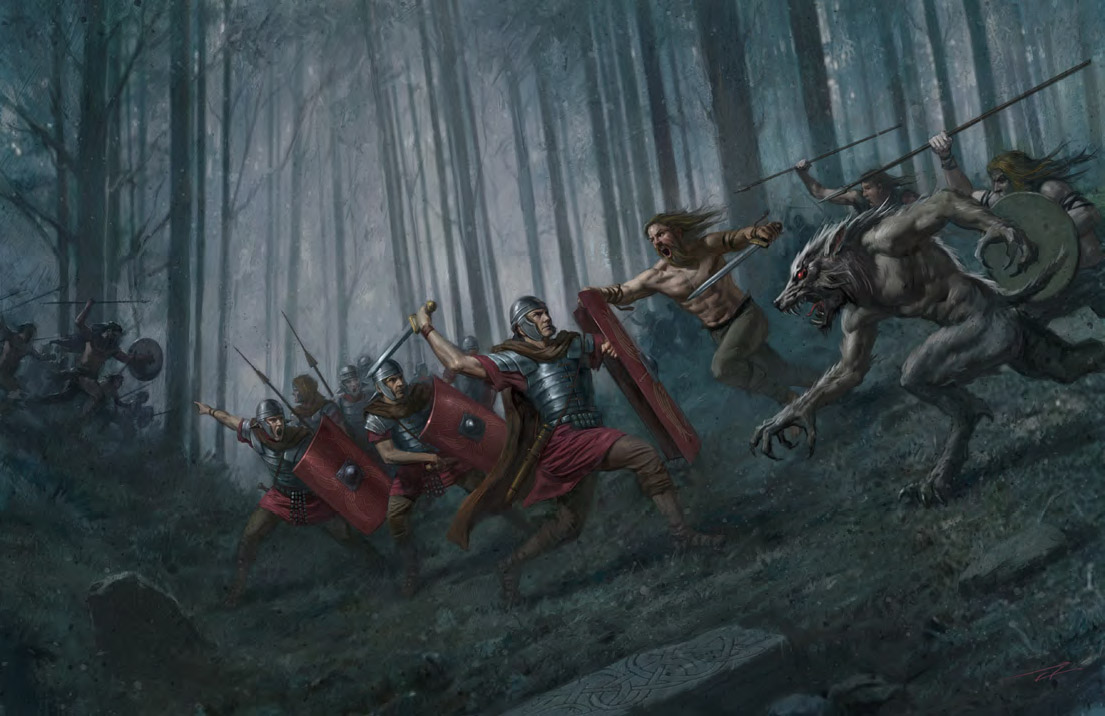
Barbarians get Wulfkind (werewolves); the Egyptians get Eternal Warriors (mummies);
Dacians get Ghouls and Strigoi, and so on. If you want to play the game as a
straight historical skirmish, you don’t have to include these elements at all.
If you want to play only mythological battles, you can go heavy on those
elements. Likewise, depending on the warband you choose, you could go heavy on
ranged weapons, or cavalry, or chariots. You could take lots of cheap troops,
or a few elite troops. You can tool up your basic warriors with all the wargear
under the sun. You can purchase extra miracles for your priests to dominate the
foe through magical means. The lists are flexible enough to cater for pretty
much any style of play.
The other way to add spice to the warbands is through the
inclusion of “Auxilia”, or swords for hire. There’s a list of nine in the book
(and I’d like to write more), from the mighty Cyclops to the fully customisable
Demigod (you can choose his/her skills, blessings and weaponry based on the
deity of your choice). You can have a Centaur riding alongside your Parthian Cataphracts,
or a vampiric Daughter of Lamia skulking amidst your Celtic warrior warband.
Whatever takes your fancy!
During campaign play, you need to pay Auxilia an upkeep
in points after every game in order to retain their services. If you start to
do badly and don’t earn enough points to pay them off, they up sticks and leave
your warband. Such is the downside of dealing with mercenaries, especially ones
that aren’t human.
Hitting the Campaign Trail
One of the things that the guys at Osprey specifically
wanted from me was a campaign system, ‘a bit like Legends of the Old West’
(there’s a blast from the past, eh?). So, how to go about it?

In a campaign, you start off with a small warband, and
earn a number of points at the end of each game based on your performance. The
more points you earn, the more warriors, Auxilia and/or wargear you can buy for
your force. You’ll need to pay your Auxilias’ retainers from this total, so
gathering a mercenary-heavy force can prove very costly, if powerful.
Models also gain experience, allowing them to boost their
characteristics (making those all-important Tests easier), gain special rules,
or even seek out artefacts of power, like magical swords and blessed amulets.
Lowly warriors can become fully fledged heroes, proving that the gods really
can smile on the brave. Of course, on the flipside of that, models that are
taken out of action during a game might suffer serious injury or a bad case of
death, leaving you with a shortfall to fill before your next game.
If my previous efforts are anything to go by, players
really get into the spirit of things during the campaign turn (aka the
‘post-game sequence’), goading their enemies as they make those injury rolls,
and celebrating the discovery of arcane treasure as though they’d actually
found the real-life Golden Fleece.
 There you have it – that pretty much sums up my
approach to Broken Legions. I’ve tried to be as permissive as possible with
regard to what models people can take, drawing upon as many different
archetypes and ancient nations that I could feasibly fit into this one book.
Hopefully the rules themselves will provide adequate grit for the competitive
players amongst you, and be simple enough to learn for the casual gamer.
There’s a lot going on in this one book, and the constraints of physical pages
and deadlines have meant that I still have other ideas bubbling away for this
setting. Hopefully I’ll get the chance to realise those ideas in the future.
There you have it – that pretty much sums up my
approach to Broken Legions. I’ve tried to be as permissive as possible with
regard to what models people can take, drawing upon as many different
archetypes and ancient nations that I could feasibly fit into this one book.
Hopefully the rules themselves will provide adequate grit for the competitive
players amongst you, and be simple enough to learn for the casual gamer.
There’s a lot going on in this one book, and the constraints of physical pages
and deadlines have meant that I still have other ideas bubbling away for this
setting. Hopefully I’ll get the chance to realise those ideas in the future.
Broken Legions is out now, available from all good bookshops, or direct from Osprey Publishing here.
If you like the artwork previews in this blog, check out some other work by the wonderfully talented Alan Lathwell here (he was also the illustrator of my Sleepy Hollow book).